Russia
The People UpstairsRussia is not the Greenes’ birthplace, but it becomes the most useful earthly label attached to them. In the story, the country serves simultaneously as a neighbor’s suspicion, a family cover story, a child’s first explanation of his parents’ difference, and a political fantasy that absorbs evidence of alien life into the familiar language of Cold War fear. Its importance lies in the way ordinary people repeatedly choose Russia, revolution, radiation, or mutation as explanations rather than recognize a reality beyond their cultural assumptions.
A Convenient Explanation for Difference
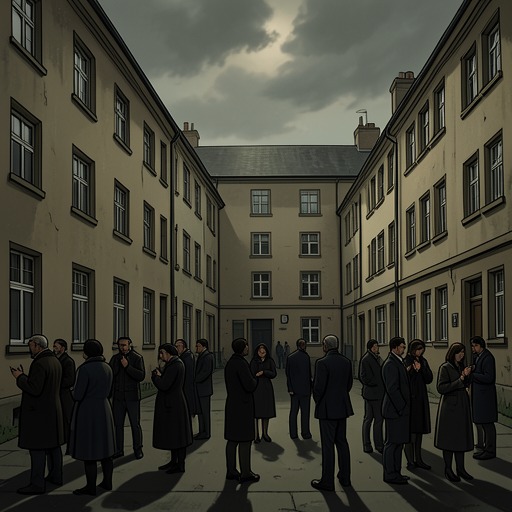
Russia first appears as an inference made by the people around the Greenes. The family’s reserve, their unusual appearance, and the careful concealment of their bodies make them seem subtly unlike their neighbors. Mrs. Gottesmann and Mrs. Schultz privately conclude that the family must be Russian because the parents are evasive about their origins. When Terence repeats this suspicion to May, she realizes that the Greenes had been watched and interpreted all along, despite believing themselves unobtrusive.
The suspicion is especially useful because it provides additional camouflage. The neighbors are not approaching the truth of the Greenes’ origin; they are placing the family inside an already available category of foreignness. Russia therefore operates less as a geographical fact than as a social explanation that turns alien difference into immigrant secrecy. Mrs. Danko’s hostile cry of “Commissars!” and her gesture against the evil eye intensify this process, combining political accusation with older fears of supernatural contamination. The Greenes’ otherness can be named as espionage, superstition, or foreign birth without ever being understood as extraterrestrial.
The Greenes’ Cover Story
After Terence begins to attract attention, Dan Greene proposes that the family allow the Russian explanation to stand. They can imply that they came from one of the Balkan states absorbed by Russia and that they remain silent because relatives might suffer reprisals. The story is deliberately indirect: it offers enough political danger to explain their secrecy without requiring a verifiable account. Russia thus becomes a protective fiction constructed from the period’s assumptions about authoritarian governments, displaced families, and hidden loyalties.
The cover also reflects the Greenes’ wider mission. May Greene and Dan Greene are Milotan secret agents sent to Earth, where the Milotan Bureau hopes eventually to establish a vast network. Their biological disguises, including plastomasks and contact lenses, conceal their bodies in public, while the Russian narrative conceals their history in conversation. The two forms of disguise work together. A strange face can be explained as foreign; evasive behavior can be explained as political danger; and both explanations keep observers within human categories.
The plan carries a genuine risk. Dan warns that it could be amusing only in the abstract if the family were imprisoned as Russian spies, since he would lose his sense of humor once the danger became real. Russia is therefore not a harmless disguise but a label with institutional consequences. The same Cold War suspicion that protects the Greenes from curiosity could also expose them to surveillance, detention, and accusations of disloyalty.
Terence’s First Geography
When May and Dan finally decide to tell Terence that he comes from somewhere far away, he answers immediately that the family is from Russia. His answer shows how completely the surrounding culture has supplied his imagination with its available geography. He does not infer Milotis from his parents’ secrecy or bodily difference; he reaches for the explanation he has heard in the apartment house.
The parents attempt to correct him by saying that their origin lies still farther away, but Terence guesses China before he can accept the possibility of another planet. He asks whether that is why they wear masks, then objects that Chinese people are yellow rather than green. His reasoning is childish, but it is also a precise demonstration of the story’s classificatory logic: visible difference must belong to a known human nationality. Even Terence’s recognition that his parents wear masks is absorbed into an earthly ethnic explanation.
The revelation fails because Terence trusts his teacher’s authority more than his parents’ impossible claim. Miss Chase insists that there are no people on other planets and no space travel, and she treats such ideas as childish nonsense. Terence argues that she is the teacher, making institutional education stronger than family testimony. His faith in her also prevents May and Dan from simply dismantling his confidence in school. The Russian explanation remains more credible to him than Milotis because Russia belongs to the world his education recognizes.
Cold War Absorption of the Alien
Miss Chase’s teaching turns Russia into a political contrast with the United States. She tells Terence that Russian refugees should not be ashamed of being Russian and should work to make Russia a good country like the United States. In this framework, Russia is both a dangerous government and a homeland from which decent people may flee. The story makes the Greenes’ alien situation pass through that familiar moral structure: the parents can be treated as foreign refugees, while their supposed origin remains politically intelligible.
May and Dan respond to the possibility of sustaining the disguise by joking that they may need to study Russian. The joke reveals how quickly the cover story becomes an obligation. To survive on Earth, the Greenes must not merely conceal their bodies; they must be prepared to perform the identity that human observers have assigned to them. Their caution is heightened when Dan imagines being jailed as Russian spies. Russia consequently marks the narrow boundary between successful assimilation and official persecution.
The Cold War association becomes still more powerful when the Soviet Union launches its first satellite. May and Dan hope the event will persuade Miss Chase, and through her Terence, that space travel and extraterrestrial life are not ridiculous. Instead, Miss Chase dismisses the satellite as Russian propaganda. The launch, which might have opened a path toward scientific recognition of the Greenes’ truth, is neutralized by political interpretation. Even actual technological evidence of space travel cannot overcome a worldview that converts the unfamiliar into propaganda.
Misrecognition and Narrative Significance
Russia’s final force is its ability to absorb the consequences of the Greenes’ secret without threatening the social order that surrounds them. When Terence’s alien body is exposed during swimming, the school principal does not imagine an extraterrestrial origin. She assumes that the boy is a freak and then connects his body to rumors about radiation from bombs. Her interpretation turns the impossible into a familiar Cold War disaster: hidden government knowledge, nuclear competition, and children damaged by fallout.
May understands that these explanations protect the family. The adults around her are so confined by their own mental categories that they prefer Russians, mutations, witchcraft, or radiation to life and science beyond their awareness. Russia is therefore part of a larger machinery of misrecognition. It does not simply disguise the Greenes; it demonstrates how a society can see evidence clearly while interpreting it through assumptions that make the truth invisible.
As a location recalled and invoked rather than visited, Russia has no independent physical setting in the supplied episodes. Its narrative reality is social and symbolic. It is spoken in the apartment house, tested within the family, reinforced by the school, and revived by public anxiety over satellites and nuclear weapons. The country becomes a screen onto which Earth projects its fears of outsiders, secret agents, ideological enemies, and altered bodies. Against that screen, the Greenes’ real origin in Milotis remains hidden in plain sight.